

How to Identify the Highest Quality Peptides
Learn how to assess highest quality peptides by purity, COAs, sourcing, handling, and batch consistency for reliable research-grade procurement.

Learn how to assess highest quality peptides by purity, COAs, sourcing, handling, and batch consistency for reliable research-grade procurement.
A common question from researchers new to handling reconstituted peptides: once a compound is drawn up, is it fine to

Peptides for research purposes require verified purity, handling control, and documentation. Learn what serious buyers should evaluate before sourcing.

Research grade peptides for sale demand purity, documentation, and control. Learn what serious buyers should verify before sourcing.

What are research grade peptides? Learn how purity, handling, testing, and documentation define peptide materials intended for laboratory use.
What actually happens to plasma levels when you split a retatrutide dose in half and inject twice a week instead of once? The pharmacokinetic math — and why once-weekly remains the only protocol with published data behind it.
A detailed research comparison of semaglutide, tirzepatide, and retatrutide — mechanism differences, key Phase 2/3 trial data, weight loss numbers, and direct links to published studies in NEJM, The Lancet, and PubMed.
A complete guide to peptide storage — lyophilized vs reconstituted, temperature ranges, freeze-thaw cycles, light sensitivity, and shelf life for common research compounds.
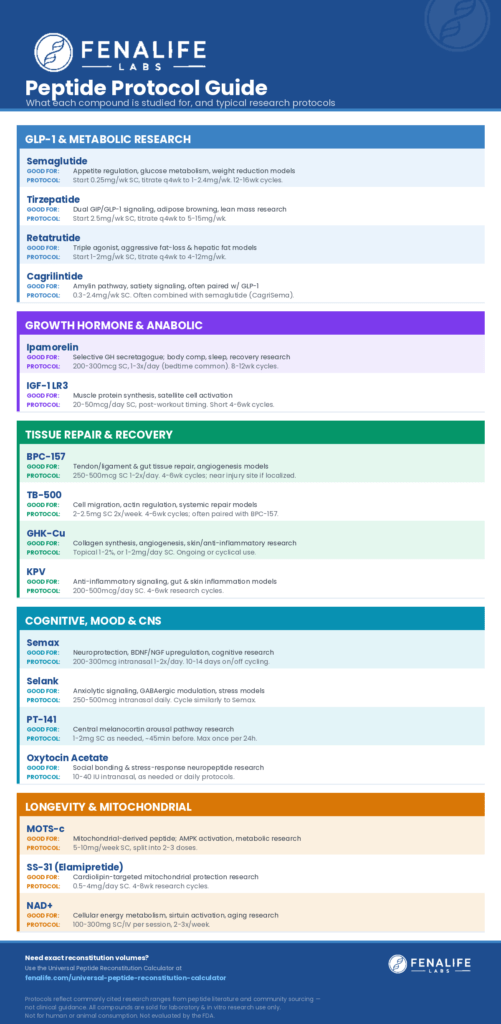
A comprehensive visual reference covering all 17 research peptides at FenaLife — mechanisms, protocols, and research categories in one infographic.
Reconstitution is where most peptide research goes wrong before it even starts. Here are the five most common mistakes — and exactly how to avoid each one.