
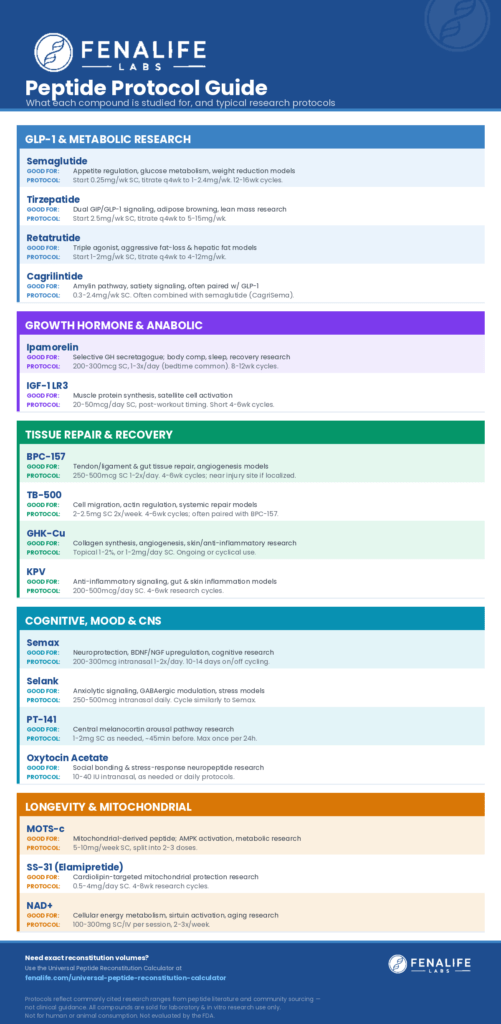
FenaLife Peptide Protocol Guide: What Each Compound Is Studied For
A comprehensive visual reference covering all 17 research peptides at FenaLife — mechanisms, protocols, and research categories in one infographic.
Foundational articles covering peptide science, amino acids, research concepts, laboratory terminology, and the basics of peptide research.
A comprehensive visual reference covering all 17 research peptides at FenaLife — mechanisms, protocols, and research categories in one infographic.
Learn the difference between endogenous and exogenous peptides, pharmacological vs physiological dosing, feedback disruption, bioidentical vs analogues, and research implications.
Learn about IRB review, informed consent, the Belmont Report principles, FDA IND requirements, and GCP standards governing ethical human peptide research.
Learn how peptide hormones regulate the endocrine system including hierarchical axes, feedback regulation, pulsatile secretion, and carrier proteins relevant to GH, HPG, and HPA axis research.
Learn what biased agonism is, how it explains why different peptides at the same receptor produce different effects, and examples in GHS-R1a and GLP-1R research peptides.
Learn the legal framework governing research peptides including FDA RUO status, FD&C Act, DEA scheduling, WADA anti-doping rules, and institutional compliance requirements.
Learn the research peptide translation pathway from preclinical studies through Phase 1-3 clinical trials, regulatory approval, translation success stories, and the translation gap.
Learn how the gut microbiome interacts with peptide signaling including GLP-1 secretion regulation, antimicrobial peptide microbiome shaping, and serotonin production connections.
Learn what peptide aggregation is, which peptides are most prone to aggregating, conditions that promote it, how to detect it, and prevention strategies for research peptide handling.
Learn the complete peptide quality control chain from starting materials through SPPS, preparative HPLC, analytical characterization, and lyophilization to understand what makes a high-quality research peptide.