
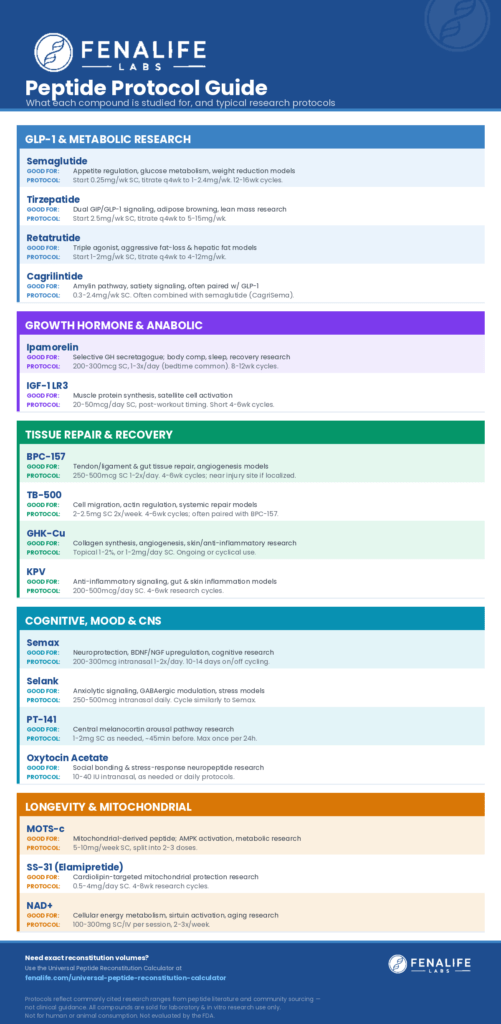
FenaLife Peptide Protocol Guide: What Each Compound Is Studied For
A comprehensive visual reference covering all 17 research peptides at FenaLife — mechanisms, protocols, and research categories in one infographic.
A comprehensive visual reference covering all 17 research peptides at FenaLife — mechanisms, protocols, and research categories in one infographic.
Learn what peptide stacks are in research, how complementary mechanisms are selected, common research stack examples including CJC-1295 plus Ipamorelin, and design considerations.
Step-by-step guide to peptide dosage calculation for researchers. Covers reconstitution concentration, dose volume calculation, weight-based animal dosing, and unit conversions.
IGF-1 LR3 is a modified insulin-like growth factor-1 with extended half-life due to reduced IGF-binding protein affinity, the standard IGF-1 analogue for cell culture and preclinical research.
Ipamorelin is a pentapeptide GHRP and selective ghrelin receptor agonist that stimulates GH release with minimal cortisol or prolactin effects.
BPC-157 and TB-500 are the two most commonly combined peptides in preclinical recovery and repair research. Each targets different aspects
PT-141 (bremelanotide) is a cyclic heptapeptide melanocortin receptor agonist engaging MC4R through a central mechanism, making it distinct from peripherally-acting compounds.
Why Equipment Selection Matters The syringe and needle you choose shape every aspect of injection technique — dosing accuracy, tissue
Reconstitution Fundamentals Lyophilized peptides are stable powders until you add solvent. The reconstitution step sets the concentration of every dose
Subcutaneous Injection Technique Subcutaneous delivery places the compound in the fatty tissue layer beneath the skin. It is the most